





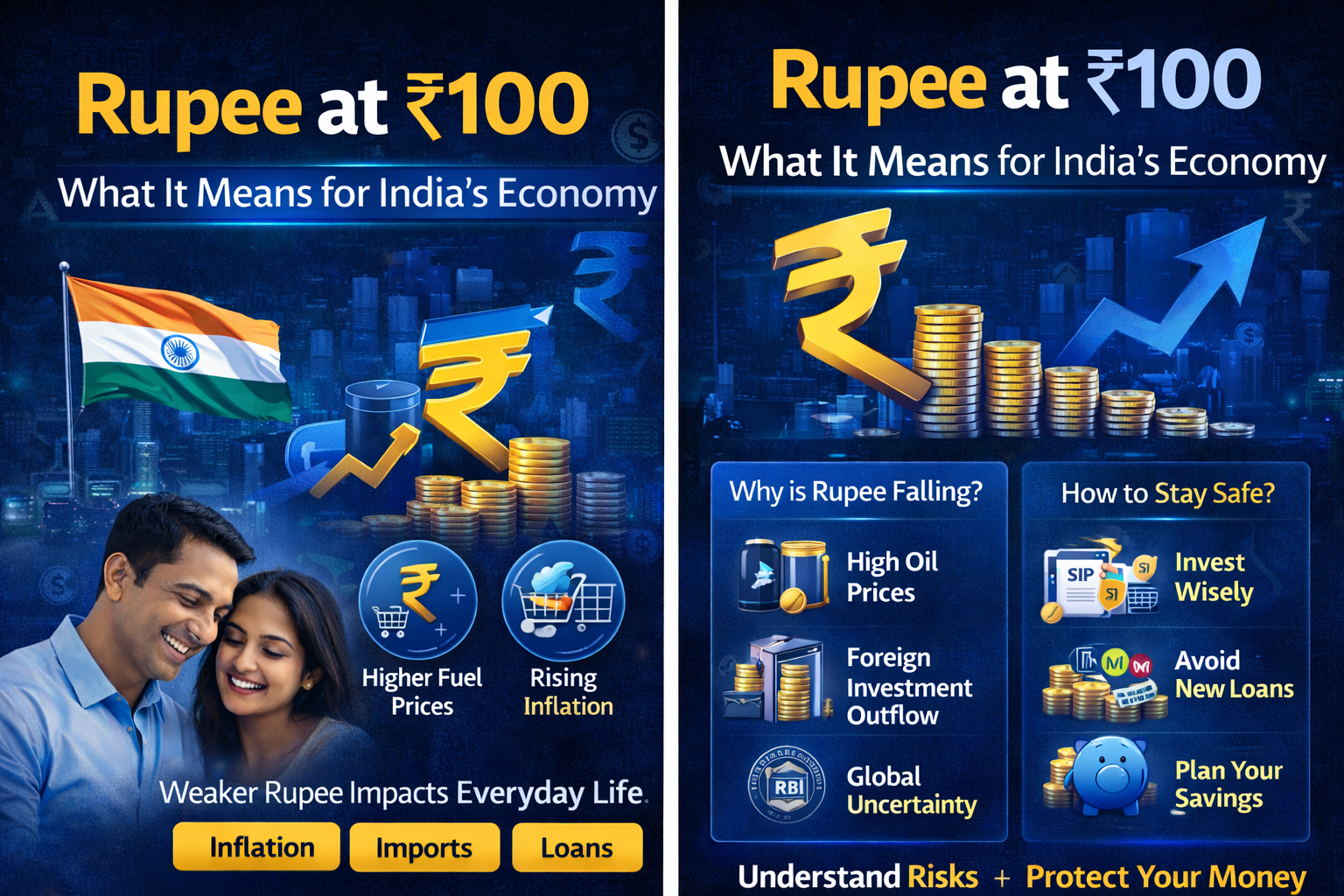
🧭 Introduction: Why Everyone Is Talking About “Rupee at 100”
In recent weeks, one topic has started dominating financial discussions in India — the possibility of the rupee touching ₹100 against the US dollar. While this number may look like just another exchange rate, it actually carries deep meaning for the economy, businesses, and even your daily life.
The Indian rupee has already weakened significantly and crossed important levels in recent months. Experts warn that if it reaches ₹100, it could become a serious reality check for India’s economic ambitions.
But what does this really mean for you? Is it a crisis or just a normal economic cycle? Let’s understand everything in simple words. Rupee at 100 may be hamper the daily life.
💰 What Does “Rupee at 100” Actually Mean?
When we say rupee at 100, it means:
👉 1 US Dollar = ₹100
This shows that the rupee has lost value compared to the dollar. A weaker currency means you need more rupees to buy the same dollar.
This may sound technical, but the impact is very real. From petrol prices to mobile phones, many things in India depend on imports. And when the rupee weakens, imports become expensive.
📉 Why Is the Rupee Falling?
🌍 1. Global Factors (Biggest Reason)
The global situation is currently unstable. Rising oil prices and geopolitical tensions have pushed investors toward safer assets like the US dollar.
- Oil prices have surged due to global conflicts
- Investors are pulling money out of emerging markets like India
- Dollar demand is increasing globally
This has directly weakened the rupee.
🛢️ 2. High Oil Prices
India imports a large portion of its oil. When oil prices increase:
- India needs more dollars
- Demand for dollar rises
- Rupee weakens
Recent reports show crude oil prices rising sharply due to global tensions, adding pressure on the rupee.
💸 3. Foreign Investment Outflow
Foreign investors are withdrawing money from Indian markets:
- Billions of dollars are being pulled out
- This reduces dollar supply in India
- Rupee falls further
Even recent data shows large outflows from Indian equities, signaling caution among global investors.
🏦 4. RBI Policy Limitations
The Reserve Bank of India (RBI) tries to control the currency, but it faces a tough choice:
👉 Control inflation OR support growth
It cannot do both perfectly at the same time.
When RBI tries to protect growth, the rupee weakens. When it tries to control the rupee, growth slows down.
📊 Impact of Rupee at ₹100 on Common People
⛽ 1. Fuel Prices Will Rise
This is the biggest and fastest impact.
- Petrol & diesel prices increase
- Transportation cost rises
- Everything becomes expensive
A weak rupee acts like a “double tax” because both oil prices and currency depreciation increase costs.
🛒 2. Daily Life Becomes Expensive
When fuel prices rise, everything becomes costly:
- Vegetables
- Groceries
- Delivery charges
- Electricity
This leads to inflation, which directly affects the middle class.
🎓 3. Foreign Education Becomes Costly
India sends millions of students abroad every year.
If rupee weakens:
- Tuition fees increase
- Living cost rises
- Loans become heavier
Even a small depreciation can make education unaffordable for many families.
✈️ 4. Travel and Imports Become Expensive
- Foreign trips cost more
- Imported gadgets become costly
- Luxury items become expensive
This reduces discretionary spending.
🏭 Impact on Indian Economy
📉 1. Inflation Pressure
A weak rupee increases inflation because:
- Imports become expensive
- Production cost increases
- Businesses pass cost to consumers
🏗️ 2. Government Financial Pressure
The government may need to:
- Increase subsidies (fuel, fertilizers)
- Borrow more money
This increases fiscal deficit and debt burden.
🏢 3. Business and Investment Slowdown
- Companies face higher costs
- Loans become expensive
- Expansion plans slow down
Even industries like textiles and manufacturing face pressure due to rising costs and weak global demand.
📊 4. Stock Market Volatility
- Foreign investors exit
- Market becomes unstable
- Investor confidence drops
📈 Is There Any Benefit of Weak Rupee?
Yes, surprisingly there are some benefits.
🌍 1. Exports Become Cheaper
Indian goods become cheaper globally:
- IT services
- Textiles
- Pharmaceuticals
This can increase exports.
💼 2. Boost to Domestic Production
Companies may shift to:
- Local manufacturing
- Reduced imports
📉 But Here’s the Catch…
India depends heavily on imports (oil, electronics, raw materials). So the benefits are limited compared to the damage.
⚠️ Is Rupee at 100 a Crisis?
Not exactly a crisis, but definitely a warning signal.
India’s economy is still growing, but:
- Trade deficit is high
- Dependency on imports is high
- Foreign capital is important
When these factors combine, currency pressure increases.
🏦 What RBI Can Do Now
The Reserve Bank of India has several options:
✔ Increase Interest Rates
To attract foreign investors
✔ Sell Dollar Reserves
To support rupee
✔ Control Liquidity
To stabilize markets
But each step has side effects.
💡 What Should You Do as an Individual?
This is the most important part 👇
💰 1. Invest Smartly
Focus on:
- SIP (mutual funds)
- Gold (safe asset)
- Diversified portfolio
📉 2. Avoid Unnecessary Loans
Interest rates may rise → EMI increases
🌍 3. Reduce Import-Dependent Spending
Avoid:
- Luxury imports
- Foreign subscriptions
- Unnecessary gadgets
🛡️ 4. Build Emergency Fund
Inflation may rise → savings become crucial
🔮 Future: Will Rupee Really Touch 100?
It is possible, but not guaranteed.
Short-term movements depend on:
- Oil prices
- Global economy
- RBI actions
Even now, the rupee is highly volatile and under pressure due to global and domestic factors.
🧠 Final Thoughts
The idea of rupee at 100 is not just about numbers. It reflects deeper economic realities.
India is growing, but challenges remain:
- High import dependency
- Global uncertainty
- Capital flow risks
If managed properly, this situation can be controlled. But if ignored, it can impact millions of people — especially the middle class.
For now, the best approach is awareness and smart financial planning.